

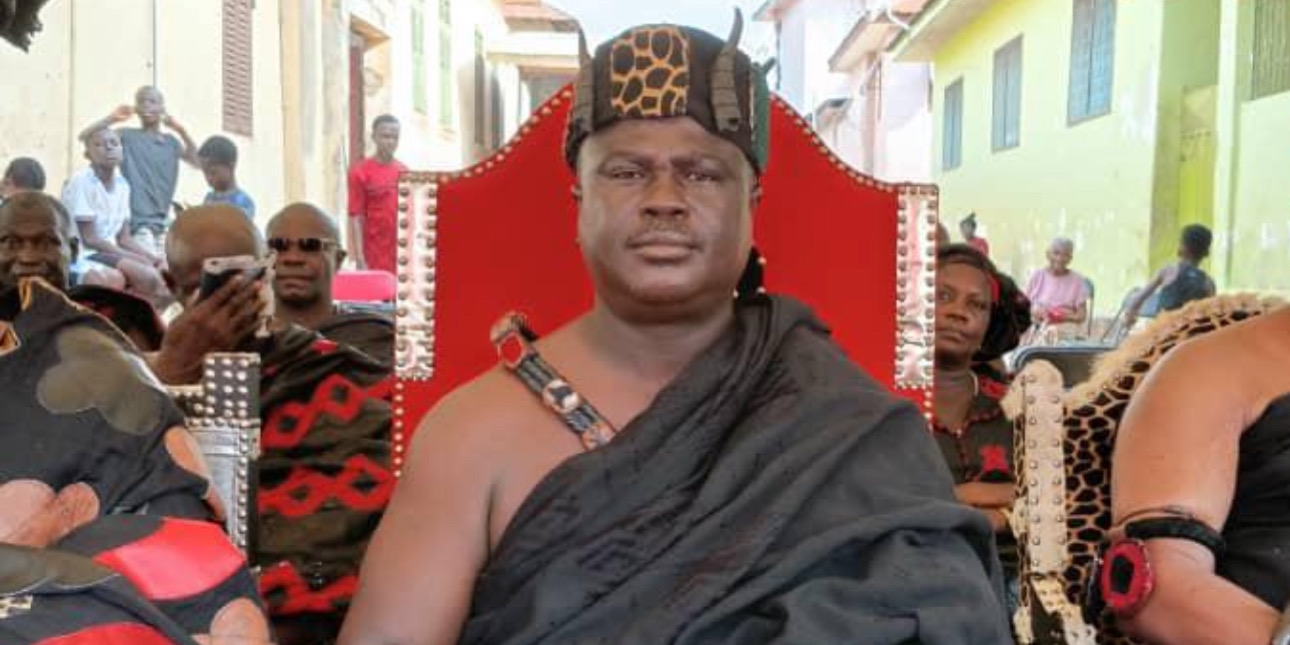
A Guardian of Tradition, Heritage, and the People of Takoradi/ Amanful
In the heart of Ghana’s Western Region, where the Atlantic Ocean meets River Whin and Butuah Lagoon bounding with River Kansaro and River Ayere a land steeped in centuries of history, culture, and royal heritage, the Ahanta Traditional Area stands as one of West Africa’s most ancient and enduring institutions.
At the centre of its governance structure is a figure of immense dignity, authority, and responsibility — Nana Obo Atta Kukuamoa IV, the Krontihene of the Ahanta Traditional Area, the Ohene of Takoradi Township, and the Divisional Chief of Takoradi/Amanful.
The triple-crown of traditional authority places him among the most significant chiefs in the Ahanta Traditional Area and Western Region of Ghana, embodying the living connection between the Ahanta people’s glorious past and their aspirations for the future.
The Ahanta Traditional Area: A Kingdom Born of Warriors and the Sea.
To appreciate the weight of Nana Obo Atta Kukuamoa IV’s role, one must first understand the land he serves. The Ahanta people — also known as the Ayinda — are an Akan people whose name is widely understood to mean “the land of Twins.” Their territory, now encompassing the Western Region of the Republic of Ghana, has historically been recognised as one of the richest coastal zones in all of West Africa, endowed with natural resources, strategic trade routes, and a fierce, independent spirit.
The Ahanta Kingdom traces its roots to between the 11th centuries, when the Ahanta people organised themselves into a powerful Kingdom stretching along the Atlantic coast, from River Ankobra to River Pra bounding to Antasua today’s Antado. The towns of Ahanta: Busua including what the Dutch once called *Taccarary* (present-day Takoradi), AgonaNkwanta, Princess Town, Butri, Axim, Sekondi, Dixcove, and Shama — became key nodes of trade, culture, and resistance.
The Ahanta were among the first African peoples to engage, resist, and negotiate with English Navigators during the reign of King Edward I, European colonial powers from 1272-1307.
Ahanta Signed three treaties these are:
On 17th Februay, 1642, Treaty of Axim established Dutch jurisdiction over Axim and surrounding areas following the Dutch conquest of Portuguese territories in the Gold Coast. Its historical map centers on the Cape Axim coastline in the Western Region of Ghana, primarily anchored by Fort Saint Anthony.
On 27th August, 1656, Treaty of Butre with the Dutch West India Company — one of the longest-standing treaties ever concluded between an African state and a European power, lasting until the Dutch departure from the Gold Coast in 1872.
On 5th January, 1683, Princes Town (or Pokesu) is located in the Ahanta West District of Ghana’s Western Region, about 5 km east of Fort St. Antonio on Manfro Hill. It is the historical site of the German-built Fort Gross Friedrichsburg, established under an 1683 treaty between Brandenburg explorers and local Ahanta chiefs. The Brandenburger and Ahanta treaties provided the legal foundation for this territory on the Gold Coast.
On 4th February, 1685, Treaty of Takoradi with the Brandenburg-Preussen West India Company — one of the longest-standing treaties ever concluded between an African state and a European power, lasting until the Brandenburg-Preussen departure from the Gold Coast in 1721 continued by Dutch Government up to 1872 and British Government up to 1957.
Treaty of Takoradi covered the total land area of Ghana’s Western Region, where the Atlantic Ocean meets River Whin and River Pra bounding with River Ennun a land steeped in the 12th centuries history, culture, and royal heritage of the Ahanta people.
The kingdom’s most celebrated warrior-king, **Badu Bonso II**, became a symbol of Ahanta resistance against colonial subjugation. He boldly banned the sale of guns and gunpowder to neighbouring tribes and European powers, and paid dearly for it — killed by the Dutch in the 19th century, his remains were only returned to Ghana in **2009**, over 171 years later. His memory lives on as a testament to the courage and sovereignty that define the Ahanta spirit.
Takoradi — at the heart of Ahanta land — carries this legacy forward today. As the commercial hub of Ghana’s Western Region and home to its deep-water harbour and oil industry infrastructure.
The Takoradi/Amanful Stool originally known as Amanful Stool is a guardian of ancient tradition and a driver of modern development.
Who Is Nana Obo Atta Kukuamoa IV?
Nana Obo Atta Kukuamoa IV holds three interlinked traditional titles that together give him a commanding presence within both the Ahanta Traditional Area and the broader regional chieftaincy hierarchy:
– Krontihene of the Ahanta Traditional Area — a senior divisional chief and second-in-command to the paramount ruler (Ahantahene)
Ohene of Takoradi Township — the traditional chief custodian of Takoradi Township.
Divisional Chief of Takoradi/Amanful — the chief of the historic Amanful village whose ancestors originally are the Conquerors of the Adom Tribe Settlement by Kojo Nda in the year 1350’s along the coast of the present Takoradi harbour before being resettled in 1927 to make way for harbour construction.
Together, these titles affirm Nana Obo Atta Kukuamoa IV’s position as a pillar of the Ahanta Traditional Area and a representative voice for the people of one of Ghana’s most strategically important cities.
The Krontihene: Understanding the Role
Origins and Meaning
The position of **Krontihene** is one of the most vital and respected offices within the Akan traditional governance system. Derived from the Akan word structure for “the one who commands,” the Krontihene historically served as thecommander of the army in the absence of the paramount chiefe, with the Akwamuhene serving as second-in-command to the Krontihene on the battlefield.
In the traditional military formation of the Akan state, the Krontihene led the vanguard of the army. Other commanders — including the Nifahene (right flank) and Benkumhene (left flank) — reported within a structure in which the Krontihene held supreme command in the field.
Second-in-Command and Caretaker of the Land
In matters of governance, the Krontihene is **second only to the Omanhene or paramount chief**. Alongside other sub-chiefs such as the Gyasehene, Akwamuhene, Nifahene, and Benkumhene, the Krontihene forms part of the **Ohene’s cabinet** — known as the *Atrankonya* — which serves as the advisory and administrative council of the traditional state.
Critically, the Krontihene is the recognised **caretaker of the land**. When the paramount chief is absent, travelling, incapacitated, or when the stool is vacant, it is the Krontihene who steps in to maintain order, preside over traditional council meetings, and ensure continuity of governance. This caretaker role is not merely ceremonial — it carries the full moral and traditional authority of the stool.
As a senior divisional chief of the Ahanta Traditional Area, Nana Obo Atta Kukuamoa IV participates actively in the deliberations of the Chiefs and, by extension forums through which Ghana’s traditional rulers engage with national policy, legislation, and development planning.
Custodian of Culture and Custom
The Krontihene is a primary custodian of the traditional area’s customs, values, and heritage. This responsibility includes:
Presiding over traditional rites and festivals — including the Ahanta Kundum festival, one of the region’s most celebrated cultural events
Adjudicating disputes — the Krontihene serves as a key arbitrator in chieftaincy, land, and community disputes within the traditional area
Safeguarding ancestral land — as caretaker of the land, the Krontihene holds in trust the stool lands that belong to the community across generations
Enstoolment and destoolment proceedings — the Krontihene plays a central role in the installation and, where necessary, the removal of sub-chiefs within the traditional hierarchy
Advising the paramount chief — as a senior chief, the Krontihene provides counsel to the Ahantahene on matters affecting the state
The Krontihene as a Modern Leader
The institution of the Krontihene has evolved significantly beyond its military origins to meet the demands of modern governance and community development. Today, the Krontihene of the Ahanta Traditional Area is expected to function not only within the palace but across multiple spheres of public life — from engaging government institutions and development agencies to championing education, youth empowerment, and economic development.
As Ohene of Takoradi Township, Nana Obo Atta Kukuamoa IV presides over a community that sits at the crossroads of Ghana’s oil and gas economy, maritime trade, and urban expansion. His role requires a delicate but firm balance — honouring the traditions of the Ahanta ancestors while positioning Takoradi for the opportunities and challenges of the 21st century.
Takoradi-Amanful: A Community With Deep Roots
The people of Takoradi/Amanful Traditional Area carry a story of resilience that mirrors the broader Ahanta spirit. Originally settled along the coastline of what is now the Takoradi harbour, the indigenous Amanful community was displaced in 1924 when colonial authorities constructed the Takoradi Harbour — one of West Africa’s first modern deep-water ports.
The resettlement split the community. One group that is the Adjua Amanful settlement of Kromanti decent followedCaretaker of Amanful Kobina Kum, to now known as New Amanful (Amanful Kuma), while the other group, guided by the queenmother, resettled at what became Takoradi Township or Takoradi Amanful — the community over which Nana Obo Atta Kukuamoa IV holds divisional chieftaincy authority today.
Despite the disruption of colonial-era displacement, the Takoradi Amanful community has preserved its identity, its royal customs, and its place within the Ahanta Traditional Area hierarchy. As Divisional Chief, Nana Obo Atta Kukuamoa IV serves as the living link between that ancestral memory and the community’s present-day aspirations.
A Stool of Service
The triple titles borne by Nana Obo Atta Kukuamoa IV are not merely honorific — they represent a covenant of service. In Akan tradition, the stool is not a throne of personal power but a sacred trust. A chief sits on the stool not for himself, but for his people — the living, the ancestors, and those yet unborn.
As Krontihene of the Ahanta Traditional Area, he is the second pillar upon which the entire structure of Ahanta governance rests. As Ohene of Takoradi Township, he is the traditional father of a city that pulses with economic energy and historical pride. As Divisional Chief of Takoradi/Amanful, he is the guardian of a community that has survived displacement, division, and time — and yet remains rooted in the values of its forebears.
Together, these roles call for a chief who is a diplomat, a judge, a historian, a community advocate, and a guardian of culture — all at once.
Conclusion
Nana Obo Atta Kukuamoa IV stands in a long line of custodians who have kept the Ahanta Traditional Area’s flame alive through centuries of change. In an era when rapid urbanisation, resource extraction, and social transformation reshape communities across Ghana’s Western Region, the role of the Krontihene has never been more vital.
He is the voice of the ancestors in the councils of the living. He is the bridge between a warrior kingdom’s ancient glory and the promise of a modern, united, and prosperous Ahanta people.
Long may he reign.
— for the good of the Ahanta state.
Published in recognition of the rich chieftaincy heritage of the Ahanta Traditional Area, Western Region, Ghana by Edward Bab Ababio, Traditional Governance Press